The Art of Describing or Painting Heraldic Devices or Armorial Bearings
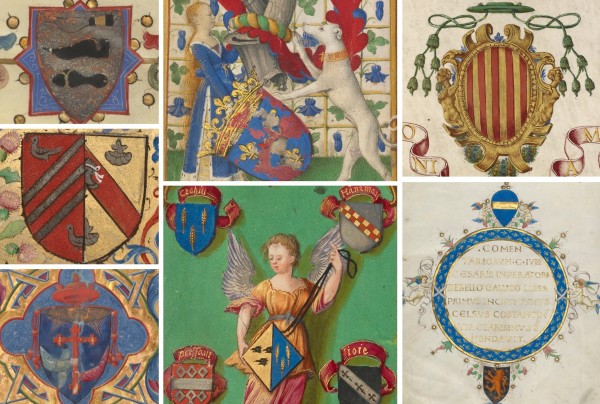
Coats of arms in the Getty manuscripts collection
Numerous illuminated manuscripts in the Getty collection characteristic coats of arms, signs of prestigious ownership from the distant past. These heraldic devices characteristic on books made for guilds, knights, cardinals, bishops, dukes, families united past marriage, humanists, regal advisors, and young women.
This post is the first in an occasional series that shares insights into the lives of some of the illustrious patrons from medieval and Renaissance Europe, and also explores mysteries that still remain about some of the more than enigmatic emblems and devices.
A Mystery Resolved
For our kickoff mystery, allow'due south look at a tiny (4 1/2 by 3 1/4-inch) 15th-century French book of hours, or personal prayer book, in the Getty collection. This is the final department of a magnificent manuscript that was divided at some point into iii separately bound books. Scholars identified the Getty manuscript as a long-lost volume from this work through the text and the outstanding quality of the illuminations past Jean Fouquet, who worked for Kings Charles Vii and Louis XI of French republic. The other two volumes are at present in the National Library of the netherlands in The Hague.
While this identification lonely is worthy of celebration, manuscript specialists were too able to place the original patron of the book by decoding the coats of artillery included in numerous illuminations throughout the three volumes.
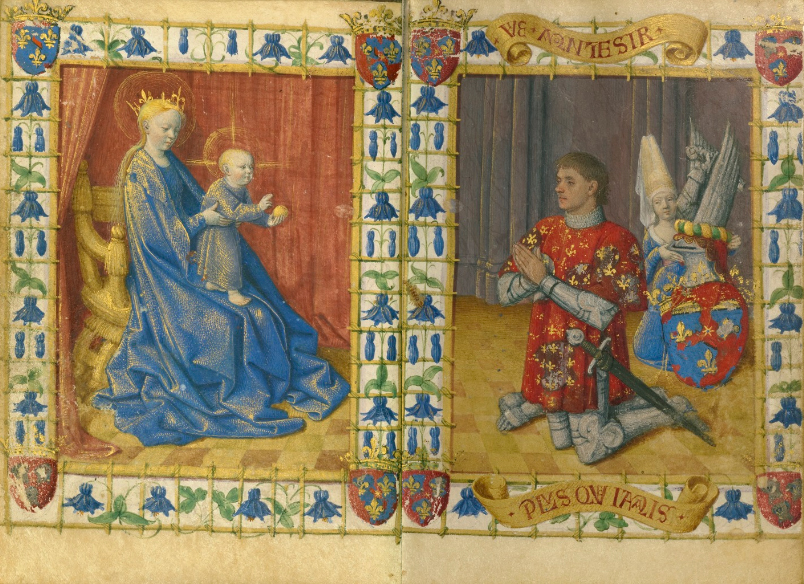
The Virgin and Child Enthroned; Simon de Varie Kneeling in Prayer, Jean Fouquet, Hours of Simon de Varie, Paris, 1455. The J. Paul Getty Museum, Ms. 7, fol. 1v-ii
The coats of arms are desperately damaged in the volumes at The Hague, and those in the Getty volume were overpainted in the 1600s with the artillery of the Bourbon-Condé royal family, obscuring the original details. With the aid of a microscope, ultraviolet light, and infrared reflectography—the Getty never performs invasive or damaging tests on manuscripts—art historian James H. Marrow was able to determine the content of the original coat of arms: 3 silverish helmets on a red shield, with a gold star in the eye. In heraldic terms, this is described every bit gules, three helmets argent, at the fess point an estoile; or to use the original French heraldic terms, de gueules à trois heaumes d'silvery accompagnés d'une étoile d'or en abîme.
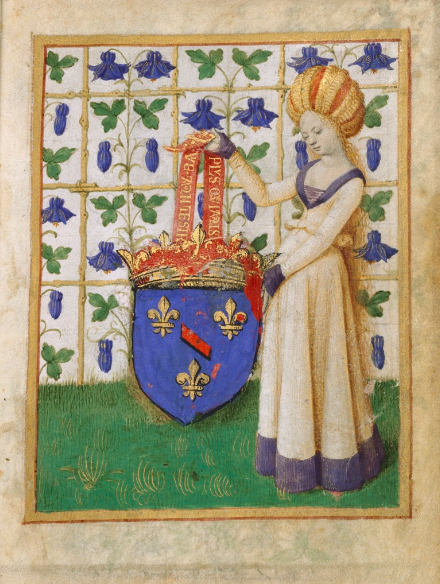
Coat of Arms Held by a Woman, Jean Fouquet, in Hours of Simon de Varie, made in Paris, France, 1455. The J. Paul Getty Museum, Ms. 7, fol. 1. Here the original glaze of arms has been covered by the artillery of the Bourbon-Condé family.
Despite this breakthrough, another mystery emerged: the specific coat of arms had yet to be identified with a item family unit. That is, until François Avril, the preeminent former curator of manuscripts at the Bibliothèque nationale in Paris, located the crest in the vaulting of the chapel of the Hôtel Jacques Coeur in Bourges. Along with examples from document seals, Avril continued the crest in the manuscript with the Varie (or Varye) family.
Given that the gold star is a heraldic device to denote younger members of a family unit, Avril was even able to pinpoint Simon de Varie, younger brother of Guillaume de Varie—whose arms appear in the chapel of the Hôtel Jacques Coeur—as the patron. Avril confirmed the theory by noting that the motto used in the manuscript VIE A MON DESIR (life according to my desire) is an anagram of SIMON DE VARIE.
All of these combined efforts truly stand for an art historical success story.
…And A Mystery to Conquer
Let'south turn our attention to another manuscript mystery—ane that has still to exist solved.
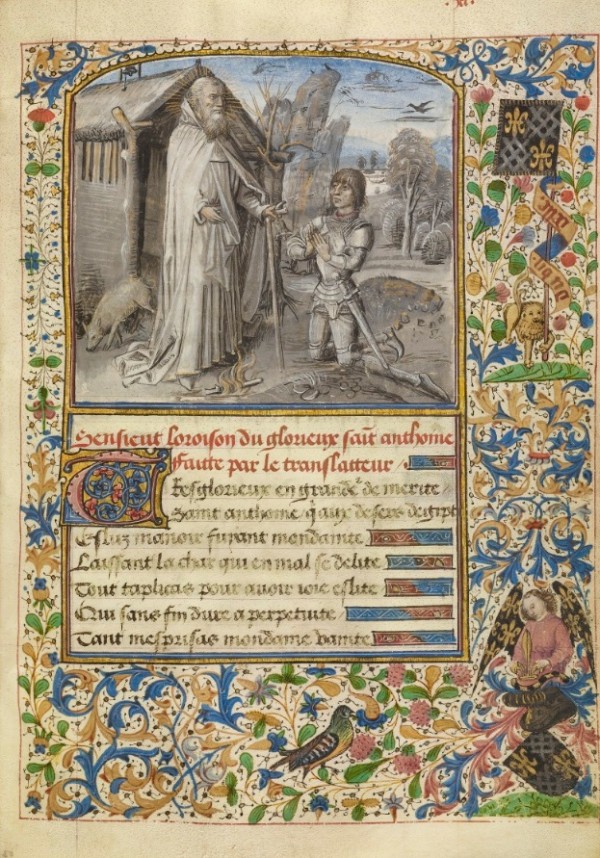
A Young Knight in Armor Kneeling in Prayer before Saint Anthony, Dreux Jean, inThe Invention and Translation of the Body of Saint Anthony, nearly 1465-70. The J. Paul Getty Museum, Ms. Ludwig Eleven eight, fol. l
On this manuscript folio, a handsome knight with long hair and shiny armor kneels in perpetual prayer and veneration before Saint Anthony Abbot of Egypt, whose life and posthumous miracles are recounted and wondrously visualized in the manuscript.
The patron's enigmatic coat of artillery features on several busy pages of the rather short book, either emblazoned on a shield topped by a helmet and held by an angel (whose wings mirror the fleurdelisé pattern on the escutcheon) or held by a king of beasts as a banner or standard. In heraldic linguistic communication, the arms can be described as follows: Sable Quarterly I and Four fleur-de-lis Or, Two and III fretty Argent. These devices declare the early owner'due south identity and yet have simultaneously resisted decipherment, befuddling scholars.
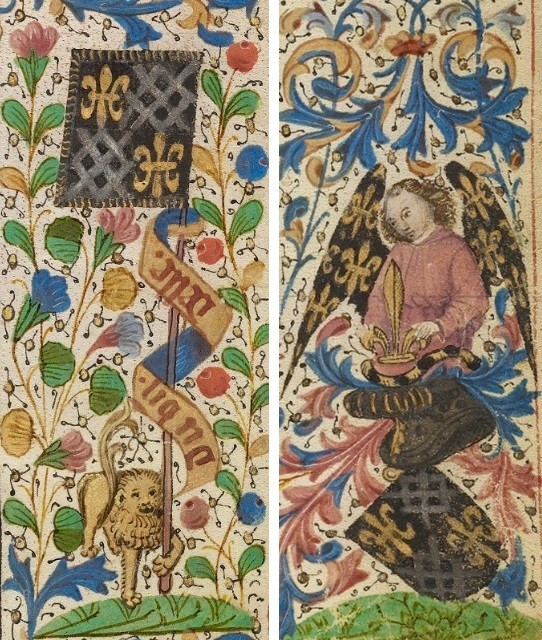
A Young Knight in Armor Kneeling in Prayer before Saint Anthony (details), Dreux Jean, in The Invention and Translation of the Trunk of Saint Anthony, about 1465-70. The J. Paul Getty Museum, Ms. Ludwig Eleven 8, fol. 50
The knight'due south motto, however, tin can be easily read: Du bien d'elle, a French phrase that may exist translated as "Of her goodness," perhaps referring to a bond or vow taken for a lady past a knight devoted to a chivalric order dedicated to Saint Anthony. Additionally, a puzzling phrase was penned, presumably in a 15th-century script, on the last page (folio 56v) of the manuscript: Vinc (Vive) le curé de Vincent à sont desir // P Martin [monogram] GMartin. The same mitt probable also wrote Girin Martin Prothon(otaire) (?) seen at the end of the postal service.
What are we to brand of these marks and beguiling inscriptions? We welcome your insights and suggestions!
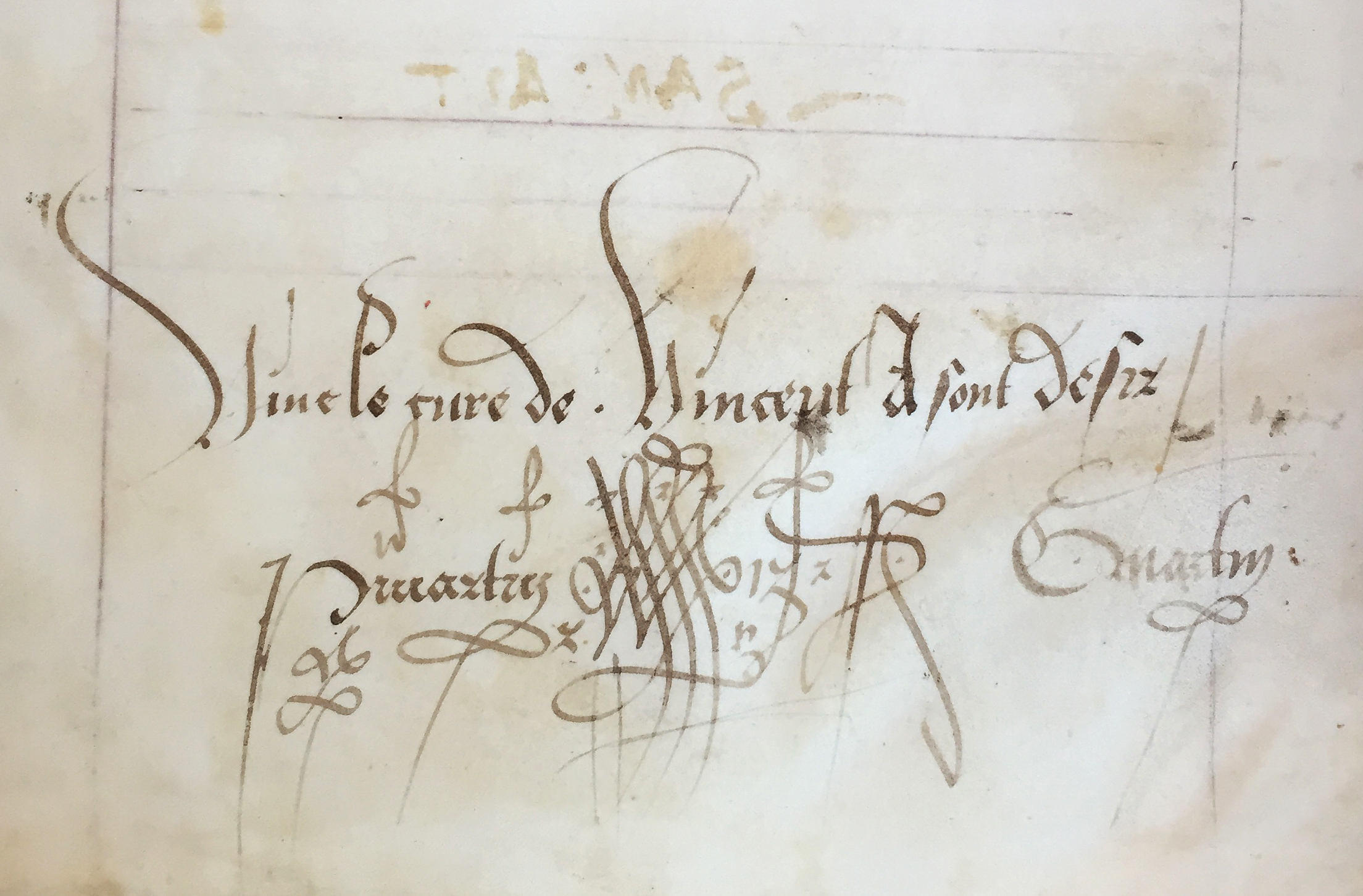
Possibly "Vinc (Vive) le curé de Vincent à sont desir // P Martin [monogram] GMartin," probably Bruges, Belgium, well-nigh 1465-70, The J. Paul Getty Museum, Ms. Ludwig XI 8, fol. 56v
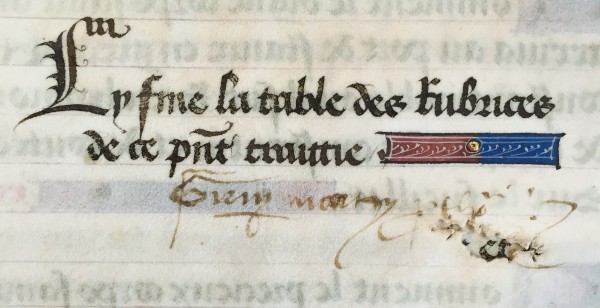
Possibly "Girin Martin prothonotaire," probably Bruges, Kingdom of belgium, almost 1465-70, The J. Paul Getty Museum, Ms. Ludwig Eleven 8, fol. five
Further Reading
The Hours of Simon de Varie, James H. Marrow, Los Angeles: J. Paul Getty Museum, 1994. Pages iii–11 cover the rediscovery of the volume now in the Getty drove and the identification of its original patron.
Illuminating the Renaissance: The Triumph of Flemish Manuscript Painting in Europe, Thomas Kren and Scot McKendrick, Los Angeles: J. Paul Getty Museum, 2003. Pages 213–215 discuss the manuscript and provide boosted bibliography.
mcmahonthempanince.blogspot.com
Source: https://blogs.getty.edu/iris/heraldry-illuminated-deciphering-coats-of-arms-and-other-manuscript-mysteries/
0 Response to "The Art of Describing or Painting Heraldic Devices or Armorial Bearings"
Post a Comment